
An Australian plastic surgeon can post a great deal on social media – process, surgical environment, anaesthesia, recovery, myth correction, credentials and peer-facing education – without showing a single result, quoting a single patient, or promoting a single procedure. The content that travels furthest is rarely the content the advertising rules restrict. The surgeons reaching the largest Australian audiences right now are doing it by explaining how things work, not by demonstrating what they can do.
An Australian plastic surgeon advertising a regulated health service on social media is bound by the advertising provisions of the Health Practitioner Regulation National Law, the AHPRA advertising guidelines, and – for work falling within the definition of cosmetic surgery – the Medical Board of Australia’s guidelines for registered medical practitioners who advertise cosmetic surgery, in effect since 1 July 2023. The National Law prohibits testimonials outright, and prohibits advertising that creates an unreasonable expectation of beneficial treatment.
A point of precision worth making, because it is widely muddled: AHPRA’s guidelines on advertising higher risk non-surgical cosmetic procedures, published in June 2025 and commencing 2 September 2025, are directed principally at registered health practitioners other than medical practitioners. They have reset expectations across the whole cosmetic sector and are worth reading, but a specialist plastic surgeon’s primary advertising instruments remain the National Law and the Medical Board’s 2023 cosmetic surgery guidelines. Practitioners should confirm which instruments apply to their own scope of practice.
The list is genuinely constraining, and it has left a lot of specialists concluding social media is not worth the risk. The more useful question is what the rules leave untouched – and that turns out to be the material that performs best anyway.
The guidelines and the algorithm point the same way because promotional content is not what audiences watch. What the rules discourage – outcome claims, patient results, testimonial-style endorsement – is also what people scroll past, because it reads as advertising and everyone has learned to ignore advertising.
There is some evidence for this, though it should be read with care. A February 2022 cross-sectional study published in Aesthetic Surgery Journal Open Forum examined the 20 most recent Instagram posts from each of the top 10 global plastic surgeons – 200 posts in total – and found 64.5% were marketing content and only 4.5% educational, while engagement was highest for personal and educational posts. That is a small, global, four-year-old sample rather than an Australian one, so treat it as directional rather than definitive.
What audiences reliably stop for is process: the parts of surgery patients cannot see and are quietly anxious about. Not “here is what I can do for you,” but “here is what actually happens in that room.”
Dr Michael Kernohan, a specialist plastic surgeon in Sydney and a Luna Digital Marketing client, has built substantial reach on short-form video by explaining theatre process rather than procedures or results. Four of his reels reached a combined audience of roughly 1.8 million views: an explainer on why surgeons use a warming device in theatre (221,000 views), a clip on recovery (574,000 views), an explanation of how anaesthetists know a patient is genuinely asleep (847,000 views), and one on how patients are woken safely (157,000 views).
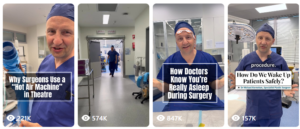
Reels with no patients and no results between them. The best performing explains how anaesthetists know you are asleep.
Four things those videos have in common:
The highest-performing of the four answers a question almost every surgical patient has privately wondered about and few ask out loud. That is the pattern: the reach came from addressing anxiety, not from demonstrating capability. In Dr Kernohan’s case the visibility has also generated real enquiry interest – from an audience that arrived because he explained something, not because he sold something.
The categories below sit well clear of the restricted zone, because none involves promoting a procedure or depicting an outcome.
| Category | Why it works |
|---|---|
| Process and environment – what theatre is like, what the equipment does, how the team operates | Answers questions patients are too self-conscious to ask; advertises nothing |
| Anaesthesia and recovery explainers | Among the highest-anxiety topics for surgical patients, and almost entirely uncovered by surgeons |
| Myth correction | Naturally shareable – correcting a misconception is more interesting than confirming one |
| The questions you are asked every week in clinic | Already answered daily; recording the answer once costs nothing and is inherently useful |
| Credentials and training pathway | Factual, permitted, and useful to patients working out who they are looking at |
| Peer-facing content for referring GPs and colleagues | Sits outside consumer advertising restrictions almost entirely and feeds referrals directly |
This table is a starting point for a conversation with your medico-legal adviser, not a substitute for one. Luna builds programmes of this kind through its organic social media management service.
Not usually – moderation is generally the better trade than a blanket switch-off. A practitioner is responsible for testimonial-style content on channels they control, including comments on their own posts, and disabling comments, tagging and reviews is an accepted way to manage that exposure. Plenty of practitioners do exactly that.
The difficulty is that engagement is a distribution input. Switching comments off protects you and simultaneously suppresses the reach you were building. It is the safest option and the most costly one, and it is usually chosen by default without anyone weighing the second half of that sentence.
The middle path is active moderation: remove testimonial-style comments as they appear, do not engage with praise about results (a like or a “thank you” is an interaction), and post content that does not invite result-based comments in the first place. Process content does this naturally – nobody replies to a video about anaesthetic monitoring with a testimonial.
Worth auditing at the same time: any review widget on your own website, and any paid directory listing with reviews attached. Both sit closer to your own advertising than an organic mention elsewhere, and both are frequently forgotten remnants of an older site build. Luna covers this territory in its social media marketing work.
Start with the three questions you answered most often in clinic last week. Record yourself answering them, in scrubs, wherever you already are. No patient, no result, no claim. That is the entire formula – the reach in the examples above came from a surgeon explaining a warming blanket.
Set the frequency at what survives a heavy operating month. The failure mode in specialist practice is almost never poor content; it is a programme that quietly stops. Luna’s social media marketing case study sets out how the process runs when the surgeon’s only commitments are the recording and the final approval.
The Medical Board’s guidelines for practitioners who advertise cosmetic surgery impose specific restrictions on the use of images, and the National Law separately prohibits advertising that creates an unreasonable expectation of beneficial treatment. Because the requirements are detailed and have been revised, any use of clinical imagery should be confirmed against the current AHPRA guidance and with your medico-legal adviser before posting.
It depends on whether it promotes a regulated health service. Content explaining how anaesthesia works, with no reference to services offered and no invitation to book, is generally not advertising. Content framed around a procedure the practitioner performs is more likely to be captured, even where it is presented as education. The safest test is whether a reasonable viewer would take the post as promoting the practitioner’s services.
The advertising provisions of the National Law prohibit testimonials in advertising a regulated health service, and an influencer describing their own experience of a procedure will generally be a testimonial. AHPRA’s 2025 guidelines on advertising higher risk non-surgical cosmetic procedures specifically address the use of influencer testimonials. Practitioners should treat influencer arrangements as high risk and take advice before entering one.
Responsibility attaches to advertising on channels the practitioner controls, which includes their own social media posts. A practitioner is not responsible for what patients write independently on third-party review platforms, but comments on their own page sit within their control and should be moderated. Engaging with or endorsing such a comment increases exposure rather than reducing it.
If you have been treating social media as a compliance risk to be avoided rather than a channel with a narrow but genuine opening, it may be worth a look at where your own content currently sits. Our free AHPRA marketing checklist covers the ways specialists most often breach AHPRA and TGA rules without realising. Ready to talk strategy? Book a free 30-minute social media audit. We’ll look at what you’re posting now, where it sits against the advertising rules, and which two content types are most likely to survive your operating schedule.
This article is general information about marketing practice, not legal or compliance advice. Verify your own content against the current AHPRA advertising guidelines and the Medical Board’s guidelines for cosmetic procedures, and seek advice where you are unsure.