
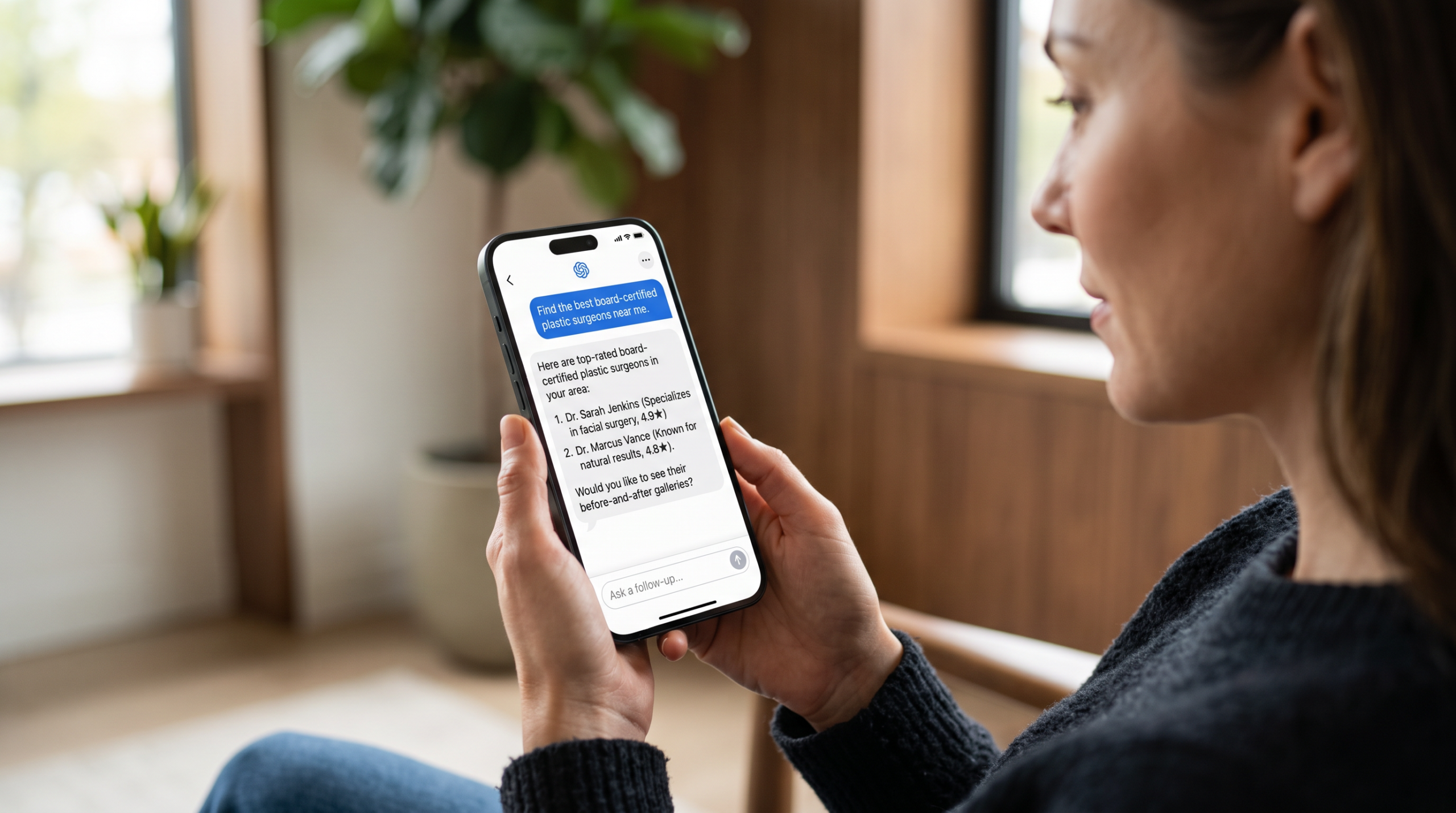
A plastic surgeon gets found online when Google and AI answer engines can find, trust and repeat the same accurate facts about the practice: the rooms, the credentials and the contact details. That takes an accurate Google Business Profile, consistent listings, a website written in clear question-and-answer form and structured data, all inside the advertising rules of the Australian Health Practitioner Regulation Agency (AHPRA) and the Medical Board of Australia. Search engine optimisation (SEO) earns a place in Google’s results. Answer engine optimisation (AEO) earns a mention inside the answers given by tools such as Google AI Overviews, ChatGPT, Perplexity and Microsoft Copilot. For a referral-driven practice, both support the referrer relationship, because GPs and patients check a surgeon online before acting.
This guide is practical. It includes a compliant Google Business Profile template, a before-and-after rewrite, schema and robots.txt snippets your web developer can use, and a 10-minute AI test to run each quarter.
Local SEO for a plastic surgeon is the process of making the practice easy to find and verify in location-based searches, whether a GP is checking a referral destination or a prospective patient is researching surgeons in their city. It is a branch of search engine optimisation (SEO), the practice of improving a website so search engines can find, understand and rank it. For a time-poor surgeon, the value lies in a small set of accurate foundations that need only occasional maintenance.
Word-of-mouth referral remains central to most surgical practices, and local SEO does not replace it. It supports it, because a referral often prompts a quick online check of the surgeon’s location, rooms and credentials.
Answer engine optimisation (AEO) is the practice of making a surgeon’s information easy for AI tools to understand, trust and cite when they answer questions. SEO aims for a ranked link that someone clicks. AEO aims for a mention or citation inside the answer itself, in tools such as Google AI Overviews, Google AI Mode, Claude, ChatGPT, Perplexity, Gemini and Microsoft Copilot. AEO builds on SEO rather than replacing it, because AI tools often draw on pages that search engines can already crawl and trust.
| SEO | AEO | |
|---|---|---|
| Goal | Rank in Google Search and Maps | Be mentioned or cited in AI-generated answers |
| Typical search | “plastic surgeon Bondi Junction” | “Who is the best plastic surgeon near Bondi Junction who does tummy tucks?” |
| What helps | Accurate listings, relevant pages, links, technical health | Consistent facts across sources, direct answers, structured data, credible third-party mentions |
| How success shows | Rankings, clicks, calls and direction requests | Mentions and citations in AI answers, and enquiries that reference them |
AEO matters because more people now ask an AI tool a full question instead of typing a few keywords, and the tool replies with a short list of names rather than ten links. If a surgeon’s details are inconsistent or thin, the AI may leave the surgeon out, or repeat outdated rooms, an old phone number or a title the surgeon cannot use. The surgeon has no direct control over what an AI tool says, but accurate source information is the strongest influence a practice has.
To be recommended by ChatGPT and similar tools, a practice needs to be reachable by AI crawlers, described consistently across the web and explained on its own website in plain, quotable answers. No one can buy or guarantee a mention in an AI answer, but five steps give a surgeon the best chance:
Each step is covered in more detail below.
A Google Business Profile matters because it is often the first thing a referrer or patient sees when they search for a surgeon by name, and it is one of the sources Google’s AI features draw on when summarising local providers. It is a free listing that shows a practice’s name, address, hours and contact details in Google Search and Google Maps, and the practice owns it once it is claimed and verified. An unclaimed or outdated profile can show the wrong rooms, phone number or hours, and AI tools may repeat those errors. No technique guarantees that a surgeon will be cited or recommended, but a complete and accurate profile removes an avoidable barrier.
A plastic surgeon’s Google Business Profile should include the practice name, a verified address for the consulting rooms, hours, a working phone number, the website URL, an accurate primary category and a plain, factual description. The table below sets out the essentials and the compliance point for each.
| Profile element | What to do | Compliance point |
|---|---|---|
| Practice name | Use the registered practice name exactly as on the website | Do not add keywords or claims to the name |
| Address, hours and phone | Keep them current, and clearly state where consultations take place | Accuracy about location supports the Board’s cosmetic surgery guidelines |
| Credentials | State only qualifications and titles that AHPRA registration supports | Check specialist title use under the Health Practitioner Regulation National Law |
| Services | List services in plain, factual language | No outcome claims, no guarantees and nothing that downplays surgical risk |
| Description | Write two or three factual sentences answering who, where and how to refer | No superlatives such as “best” or “leading” |
| Reviews | Monitor, and reply rarely and with great care | Never confirm someone is a patient or disclose health information |
Adapt this structure. It answers the questions AI tools and referrers ask, and it makes no claims about results.
Dr [Name] is a specialist plastic surgeon [registered qualifications, e.g. FRACS (Plast)] consulting at [rooms address], [suburb]. Dr [Name] operates at [hospital or accredited facility] and accepts referrals from GPs and specialists. To refer a patient or make an appointment, call [phone] or visit [website].
Use the title “specialist plastic surgeon” only if the surgeon holds specialist registration in plastic surgery on the AHPRA register.
Consistent information helps because Google and AI answer engines cross-check the same facts across many sources, and agreement between sources builds confidence. The key details are the practice’s name, address and phone number (NAP), plus the surgeon’s name, qualifications and consulting locations. AI tools treat a surgeon as an entity, a distinct person linked to specific rooms, credentials and hospitals, so conflicting details make that entity harder to confirm.
The sources that matter most for a surgeon include:
A practical approach is to keep one master record of the practice’s details and update every listing from it whenever rooms, hospital affiliations or contact details change. For surgeons with several consulting locations, each location needs its own accurate details. Practices wanting to go further can explore advanced SEO, which covers structured data and technical improvements.
AI answer engines do not publish their selection criteria, but they tend to mention surgeons whose information is consistent, clearly stated and confirmed by more than one credible source. In practice, four signals carry the most weight for a specialist practice:
What we see in practice: [Insert one real finding from Luna’s audits, e.g. “In our review of [number] Sydney surgeon profiles, [number] showed outdated rooms or phone numbers on at least one listing.” A specific, attributable number is what AI tools are most likely to quote. Delete this line if no data is available.]
A surgeon should write website content as clear questions with a direct, factual answer in the first sentence, because AI tools lift short, self-contained answers. The good news for a cosmetic or plastic surgery practice is that AEO and AHPRA point in the same direction: both reward plain facts and penalise hype.
| Before | After |
|---|---|
| “Sydney’s leading plastic surgeon, delivering results with a passion for perfection.” | “Dr [Name] is a specialist plastic surgeon who consults in [suburb] and operates at [hospital]. GPs can refer using the form on this page or by secure messaging.” |
| Superlative and outcome language that risks breaching AHPRA rules | Factual and verifiable |
| Nothing an AI tool can confirm or quote | Answers who, where and how to refer in two sentences |
Structured data, also called schema markup, is code that tells search engines and AI tools exactly what each piece of information on a page means. For a surgical practice, the most useful types are:
| Schema type | What it labels |
|---|---|
| Physician or MedicalBusiness | The practice, its locations, hours and contact details |
| Person | The surgeon, with qualifications, memberships and hospital affiliations |
| FAQPage | Question-and-answer content on the page |
| Article | Insights and blog content, with author and dates |
Google now shows FAQ rich results only for a limited set of sites, but FAQ markup still helps machines read question-and-answer content accurately. Every claim in the markup must match the visible page and stay within AHPRA rules.
A web developer can adapt this for the surgeon’s profile page. Replace every bracketed value, and include only credentials the surgeon actually holds.
<script type="application/ld+json">
{
  "@context": "https://schema.org",
  "@type": "Person",
  "name": "Dr [Full Name]",
  "jobTitle": "Specialist Plastic Surgeon",
  "url": "https://[practice-website]/[surgeon-profile]/",
  "hasCredential": {
    "@type": "EducationalOccupationalCredential",
    "name": "[e.g. Fellow of the Royal Australasian College of Surgeons (Plastic and Reconstructive Surgery)]"
  },
  "memberOf": { "@type": "Organization", "name": "[Professional society]" },
  "affiliation": { "@type": "Hospital", "name": "[Hospital name]" },
  "worksFor": {
    "@type": "MedicalBusiness",
    "name": "[Practice name]",
    "telephone": "[Phone]",
    "address": {
      "@type": "PostalAddress",
      "streetAddress": "[Street]",
      "addressLocality": "[Suburb]",
      "addressRegion": "NSW",
      "postalCode": "[Postcode]",
      "addressCountry": "AU"
    }
  }
}
</script>AI tools can read a surgeon’s website only if it is not blocking their crawlers and the key information is in the page text. Some website security settings and robots.txt files block AI search crawlers, such as OAI-SearchBot (used by ChatGPT search) and PerplexityBot, without the practice realising. Important details should also appear as text, not only inside images, PDFs or booking widgets that crawlers cannot read.
AI companies run two kinds of crawler: search crawlers, which fetch pages to cite in answers, and training crawlers, which collect content to train models. A practice can allow the first and block the second without losing AI search visibility. These lines in robots.txt make that explicit:
# Allow AI search crawlers (needed to be cited)
User-agent: OAI-SearchBot
User-agent: ChatGPT-User
User-agent: PerplexityBot
User-agent: Claude-SearchBot
User-agent: Bingbot
User-agent: Googlebot
Allow: /

# Optional: block AI training crawlers
User-agent: GPTBot
User-agent: ClaudeBot
User-agent: Google-Extended
User-agent: CCBot
Disallow: /
Blocking Google-Extended does not remove a site from Google Search or AI Overviews. Also check firewall and hosting settings, because some services block AI crawlers by default regardless of robots.txt.
A plastic surgeon can publish factual, accurate information about their qualifications, consulting locations, services and how to make an appointment, as long as the advertising is not false, misleading or deceptive, does not use testimonials and does not create unreasonable expectations of benefit. These requirements come from the Health Practitioner Regulation National Law and are explained in AHPRA’s advertising guidelines, with a practical overview in AHPRA’s summary of the advertising requirements.
Registered medical practitioners who perform cosmetic surgery must also follow the Medical Board of Australia’s guidelines for registered medical practitioners who perform cosmetic surgery and procedures. The Therapeutic Goods Administration (TGA) separately regulates advertising of medicines and devices. Some states have introduced their own cosmetic surgery facility requirements, so a surgeon should confirm the rules where they practise.
Since 1 July 2023, the Medical Board’s guidelines have required patients to have a referral before cosmetic surgery, usually from their GP. That makes clear, easy-to-find referral information on the website and Google Business Profile more important, because GPs increasingly check a surgeon online, and with AI tools, before referring.
These rules apply equally to website copy, Google Business Profile descriptions, review replies and schema markup. A simple internal rule is that nothing goes live until the surgeon has reviewed it, because the practitioner can remain responsible for advertising even when staff or an agency wrote it.
A surgeon can check what AI tools say by asking them the same questions referrers and patients ask, and noting any errors. Try this every quarter in ChatGPT, Perplexity, Google AI Mode, Gemini and Microsoft Copilot:
Record the answers and the sources each tool cites. When an answer is wrong, fix the source it relied on, such as an outdated directory listing, rather than trying to correct the AI tool directly. Some tools also offer a feedback button for reporting inaccurate answers.
| Date | AI tool | Question asked | Surgeon mentioned? | Details correct? | Source cited | Fix needed |
|---|---|---|---|---|---|---|
| [Date] | ChatGPT | Where does Dr [Name] consult? | Yes / No | Yes / No | [URL] | [Action] |
| [Date] | Perplexity | Which plastic surgeons in [suburb] accept GP referrals? | Yes / No | Yes / No | [URL] | [Action] |
| [Date] | Google AI Mode | Who is Dr [Name], plastic surgeon? | Yes / No | Yes / No | [URL] | [Action] |
Also watch website analytics for referral visits from chatgpt.com, perplexity.ai and copilot.microsoft.com, which show when AI answers are sending people to the site.
A plastic surgeon can put SEO and AEO into practice with a short checklist that needs an initial setup effort and then a few minutes each month. The steps below suit most Australian specialist practices.
To see what sustained search work looks like in practice, read Luna’s search optimisation case study. Results vary by practice and market, and both SEO and AEO compound over months rather than delivering a one-off lift.
SEO helps a surgeon’s website and Google Business Profile rank in Google Search and Google Maps. AEO helps AI tools such as Google AI Overviews, ChatGPT and Perplexity understand, trust and cite the surgeon in their answers. Both rely on accurate, consistent and compliant information.
No. AEO builds on SEO, because AI tools often draw on pages that search engines can already crawl and trust. A practice with weak SEO foundations will usually struggle to appear in AI answers.
Make sure AI search crawlers can reach the website, get it indexed in Google and Bing, keep the practice’s details identical across every listing, and answer real questions in plain language on the website. No one can guarantee or buy a mention in an AI answer.
Blocking AI search crawlers such as OAI-SearchBot and PerplexityBot stops the website from being cited in AI answers. A practice can block AI training crawlers such as GPTBot and Google-Extended while still allowing search crawlers.
Yes, because referrers and prospective patients often check a surgeon’s details online before acting on a referral, and AI tools may draw on the profile too. An accurate listing confirms the location, rooms and contact details, and supports the referral relationship.
Find the source the AI tool relied on, such as an outdated directory listing or old web page, and correct it. Then make sure the website, Google Business Profile and AHPRA register all show the same details. Corrections can take weeks or months to flow through to AI answers.
No. A surgeon must never reply to Google reviews. A surgeon should also read AHPRA’s advertising guidelines and the Medical Board of Australia’s cosmetic surgery guidelines before soliciting, displaying or republishing reviews in any advertising.
A registered practitioner can remain responsible for advertising about their practice, including content written by staff or a marketing agency. A surgeon or Practice Manager should review everything before it goes live.
SEO and AEO are gradual, and results vary by location, competition and the existing online presence. A surgeon should think in months of consistent work, and no one can responsibly guarantee a ranking, an AI mention or a referral volume.
If you would like to talk through how SEO and AEO apply to your practice, we are always happy to have a conversation.